Auraison — Management Plane Design
Date: 2026-02-23 Status: Draft (v2 — not yet implemented)
Problem
As the user plane grows to run multiple concurrent agentic workloads across tenants, and the control plane orchestrates an increasing number of Claude Code agent subprocesses, three cross-cutting concerns emerge that neither plane can own cleanly:
- Governance: who is allowed to run what, at what cost, subject to which quotas
- Observability: a unified view of agent decisions, job outcomes, and resource consumption across both planes — not just logs, but a causal trace linking control plane intent to user plane execution
- Learning loops: aggregated performance signals that feed back into model selection, system prompt tuning, and tool scoping policy
The management plane is the governance and observability substrate for the entire system. It does not route jobs or execute workloads. It watches, enforces, and learns.
Goals
- Tenant isolation: namespaces, RBAC, per-tenant quotas
- Cost and token tracking: per-job, per-user, per-tenant
- Unified observability: traces and metrics spanning both planes
- Agent decision history: immutable audit log of all agent reasoning and tool calls
- Policy enforcement: tool scoping, rate limits, actuation gates
- Evaluation loops: experiment performance data → model/config improvement signals
- Model lifecycle management: which model version each agent uses, A/B testing
Non-goals (v2 scope — not yet implemented)
- Payment processing (third-party: Stripe or equivalent)
- Real-time control plane routing decisions — management plane is advisory, not blocking (except for hard quota enforcements)
- User plane execution — the management plane never submits jobs
Architecture
Position in the four-plane stack
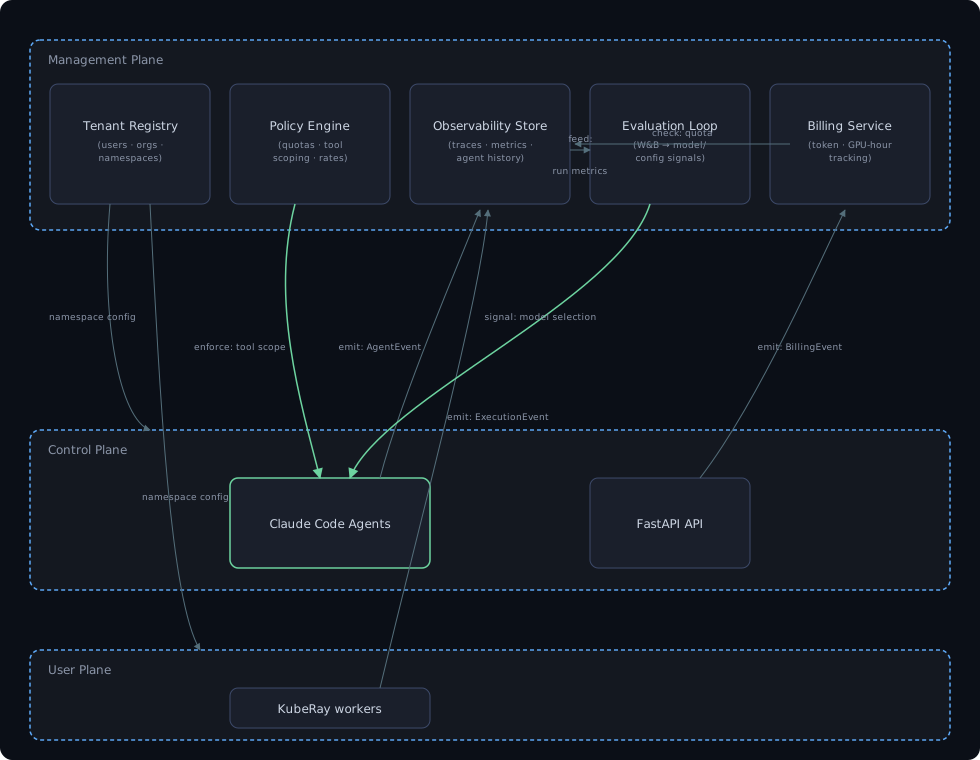
Editable Mermaid source: images/design-four-plane-position.mermaid.md
The management plane consumes events from both planes. It does not sit in the hot path of request/response between the control and user planes.
Key components
Tenant Registry
Stores organizations, users, and K8s namespace mappings. Each tenant has:
- An isolated K8s namespace in the user plane
- A set of allowed environments (
torch.dev.gpu,ros.dev.gpu, or both) - A quota configuration (see Policy Engine)
Policy Engine
Enforces governance at two points:
-
Pre-dispatch (soft enforcement, control plane side): the control plane queries the policy engine before submitting a job. If the tenant is over quota, the job is rejected before a subprocess is spawned.
-
Tool scoping (hard enforcement, agent side):
--allowedToolsstrings for each agent role are managed by the policy engine, not hardcoded in agent Python wrappers. In v2, the control plane fetches the current policy before spawning eachclaude -psubprocess.
| Policy type | v1 location | v2 location |
|---|---|---|
Tool scoping (Bash(kubectl *)) | Hardcoded in agent wrappers | Policy Engine → fetched at spawn time |
| Max job duration | JobSpec field | Policy Engine → default per tenant role |
| GPU quota | Not enforced | Policy Engine → KubeRay ResourceQuota |
| Token budget | Not tracked | Billing Service → enforced by Policy Engine |
Observability Store
A unified event store for agent reasoning and execution traces. Every claude -p subprocess
invocation emits an AgentEvent on completion. Every Ray job emits an ExecutionEvent.
AgentEvent {
  event_id:        UUID
  timestamp:       ISO 8601
  plane:           "control"
  agent_role:      "notebook" | "cluster" | "wandb" | "lakehouse"
  job_id:          UUID (optional — links to JobSpec)
  session_id:      str (claude -p session ID, enables conversation replay)
  tool_calls:      [{tool: str, input: dict, output: str, duration_ms: int}]
  tokens_in:       int
  tokens_out:      int
  exit_code:       int
  tenant_id:       UUID
}

ExecutionEvent {
  event_id:     UUID
  timestamp:    ISO 8601
  plane:        "user"
  job_id:       UUID
  environment:  "torch.dev.gpu" | "ros.dev.gpu"
  ray_job_id:   str
  status:       PENDING | RUNNING | SUCCEEDED | FAILED
  gpu_seconds:  float
  tenant_id:    UUID
}
These events are the primary input for billing, evaluation, and audit.
Billing Service
Aggregates AgentEvent.tokens_in/out and ExecutionEvent.gpu_seconds per tenant per billing
period. In v2:
- Token cost =
(tokens_in + tokens_out) × model_rateper agent invocation - GPU cost =
gpu_seconds × gpu_rateper Ray job - Both are attributed to the tenant who submitted the job
In v1, cost tracking is absent. The Billing Service is the first management plane component to implement in v2.
Evaluation Loop
The evaluation loop closes the feedback cycle between execution outcomes and model/config configuration:
ExecutionEvent (job succeeded/failed)
  → W&B run linked to job
      → WandBAgent surfaces regression signal
          → Evaluation Loop aggregates across runs
              → signal: "NotebookAgent on torch.dev.gpu has 23% failure rate for lakehouse jobs"
                  → operator action: update NotebookAgent system prompt, adjust tool scope
In v2, the evaluation loop is a scheduled job (daily or per N completions) that:
- Queries W&B for recent runs linked to control plane jobs
- Computes per-agent success rates, latency distributions, and cost efficiency
- Writes a summary to the Observability Store
- (Optional) triggers a management plane alert if a metric crosses a threshold
The evaluation loop does not automatically update prompts or models. It surfaces signals; human operators act on them.
Agent decision history
The agent decision history is the immutable append-only log of all AgentEvent records.
It serves three purposes:
-
Audit trail: for any job, you can replay the exact tool calls the agent made, in order, with inputs and outputs. This is essential for debugging unexpected agent behavior.
-
Memory substrate (v2): the Observability Store becomes the episodic memory layer for the control plane. Future agent invocations can query prior agent decisions for context ("last time this notebook failed, the agent ran X to recover").
-
Safety review: for user-plane workloads involving robot actuation, every Nav2 goal submission and every
publish_cmd_velMCP call is logged with a timestamp and session ID. Post-incident review can reconstruct the full causal chain.
Tool scoping as management plane policy
In the current v1 design, --allowedTools strings are hardcoded in each agent Python wrapper:
# v1: hardcoded in backend/agents/notebook_agent.py
ALLOWED_TOOLS = "Bash(kubectl *),Bash(ray *),Read"
This is correct for v1 but wrong architecturally: tool scoping is a governance decision, not an implementation detail. In v2, tool scoping policies are managed by the Policy Engine:
# v2: fetched from Policy Engine at spawn time
scope = await policy_engine.get_tool_scope(agent_role="notebook", tenant_id=tenant_id)
# Returns: "Bash(kubectl *),Bash(ray *),Read"  — or a more restrictive scope for untrusted tenants
This allows:
- Per-tenant tool restrictions (a trial tenant cannot run
kubectl delete) - Audit of scope changes (who changed what, when)
- Emergency scope lockdown without a code deploy
Interfaces
Event ingestion (from control and user planes)
Both planes emit events to the management plane. In v1.5, via Redis Streams. In v2, via NATS:
| Stream / Subject | Emitter | Consumer |
|---|---|---|
mp.agent.events | Control plane (after each agent invocation) | Observability Store, Billing |
mp.execution.events | User plane (KubeRay job lifecycle) | Observability Store, Billing |
mp.policy.requests | Control plane (pre-dispatch quota check) | Policy Engine |
Policy query (from control plane)
GET /api/v1/policy/tool-scope?agent_role=notebook&tenant_id=<uuid>
→ {"allowed_tools": "Bash(kubectl *),Bash(ray *),Read", "max_duration_s": 3600}

GET /api/v1/policy/quota?tenant_id=<uuid>
→ {"gpu_hours_remaining": 42.5, "token_budget_remaining": 500000, "jobs_in_flight": 2}
Implementation sequence (v2)
The management plane does not exist in v1. The recommended build sequence:
- Billing Service — instrument
run_agent()to emit token counts; store in Postgres - Tenant Registry — users + namespaces; gate job submission by tenant
- Policy Engine (quotas + tool scoping) — replace hardcoded
ALLOWED_TOOLS - Observability Store — structured
AgentEventlog; expose in dashboard - Evaluation Loop — scheduled aggregation job, W&B integration
Evolution Path
v1   — No management plane; tool scoping hardcoded; no cost tracking; no tenancy
v2.0 — Billing Service + Tenant Registry; basic quota enforcement
v2.1 — Policy Engine: dynamic tool scoping; tool scope audit log
v2.2 — Observability Store: AgentEvent log; session replay
v2.3 — Evaluation Loop: W&B → performance signals; operator dashboard
Requirements (MP-xxx)
Traces to system-level requirements in architecture/four-plane.md.
| ID | Requirement | Traces to | Version |
|---|---|---|---|
| MP-001 | The management plane shall govern tenancy, billing, quotas, and user management | SYS-001 | v2 |
| MP-002 | The management plane shall have latency of minutes, strongly consistent | SYS-001 | v2 |
| MP-003 | Management plane failure shall prevent new deployments; running agents remain unaffected | SYS-002 | v2 |
| MP-004 | The management plane shall provide tenant isolation: namespaces, RBAC, per-tenant quotas | — | v2 |
| MP-005 | The management plane shall track costs and tokens per-job, per-user, per-tenant | — | v2 |
| MP-006 | The management plane shall provide unified observability spanning control and user planes | — | v2.2 |
| MP-007 | The management plane shall maintain immutable audit log of all agent reasoning and tool calls | — | v2 |
| MP-008 | The management plane shall enforce policy: tool scoping, rate limits, actuation gates | CP-018 | v2.1 |
| MP-009 | The management plane shall provide evaluation loops: experiment data → improvement signals | — | v2.3 |
| MP-010 | The management plane shall manage model lifecycle: version tracking, A/B testing | — | v2.3 |
| MP-011 | Payment processing shall be delegated to third-party (Stripe or equivalent) | — | v2 |
| MP-012 | The management plane shall NOT make real-time routing decisions; advisory only (except hard quotas) | SYS-002 | v2 |
| MP-013 | The management plane shall NOT execute user plane jobs | SYS-001 | v2 |
| MP-014 | The management plane shall NOT be in the hot path of control ↔ user plane communication | SYS-002 | v2 |
| MP-015 | Tenant Registry shall store organizations, users, and K8s namespace mappings | MP-004 | v2 |
| MP-016 | Per-tenant config: isolated namespace, allowed environments, quota configuration | MP-004 | v2 |
| MP-017 | Policy Engine shall enforce governance at pre-dispatch (soft) and tool scoping (hard) | MP-008 | v2.1 |
| MP-018 | Policy Engine query: GET /api/v1/policy/tool-scope?agent_role=<role>&tenant_id=<uuid> | MP-017 | v2.1 |
| MP-019 | Quota query: GET /api/v1/policy/quota?tenant_id=<uuid> → gpu_hours, token_budget, jobs_in_flight | MP-005 | v2 |
| MP-020 | Tool scope shall be fetched dynamically before spawning each subprocess | MP-017, CP-018 | v2.1 |
| MP-021 | --allowedTools strings shall be managed dynamically by Policy Engine (not hardcoded) | MP-017 | v2.1 |
| MP-022 | Trial tenants shall be restricted from destructive commands (e.g., kubectl delete) | MP-004, MP-017 | v2.1 |
| MP-023 | Tool scope changes shall be audited: who changed what, when | MP-007 | v2.1 |
| MP-024 | Emergency scope lockdown shall be possible without code deploy | MP-017 | v2.1 |
| MP-025 | v1 constraints: tool scoping hardcoded, no cost tracking, no tenancy | — | v1 |
| MP-026 | v2 constraints: tool scoping from Policy Engine, quotas via KubeRay ResourceQuota, tokens via Billing | MP-017, MP-005 | v2 |
| MP-027 | Observability Store shall unify agent reasoning and execution traces | MP-006 | v2.2 |
| MP-028 | AgentEvent schema: event_id, timestamp, agent_role, job_id, session_id, tool_calls, tokens, exit_code, tenant_id | CP-019 | v2.2 |
| MP-029 | ExecutionEvent schema: event_id, timestamp, job_id, environment, ray_job_id, status, gpu_seconds, tenant_id | — | v2.2 |
| MP-030 | Billing shall aggregate tokens and gpu_seconds per tenant per billing period | MP-005 | v2 |
| MP-031 | Cost formula: token_cost = tokens × model_rate; gpu_cost = gpu_seconds × gpu_rate | MP-030 | v2 |
| MP-032 | Costs shall be attributed to the tenant who submitted the job | MP-030 | v2 |
| MP-033 | Billing Service shall NOT be implemented in v1 | MP-025 | v1 |
| MP-034 | Evaluation Loop: ExecutionEvent → W&B → regression signal → metrics → operator action | MP-009 | v2.3 |
| MP-035 | Evaluation Loop shall NOT automatically update prompts/models; surfaces signals for human action | MP-009 | v2.3 |
| MP-036 | Agent decision history shall be immutable append-only AgentEvent log | MP-007 | v2 |
| MP-037 | Decision history serves: audit trail, episodic memory for agents, safety review for actuation | MP-036 | v2 |
| MP-038 | v2 implementation sequence: Billing → Tenant Registry → Policy Engine → Observability → Evaluation Loop | — | v2 |
| MP-039 | In v1.5, AgentEvent shall be emitted to Observability Store via Redis Streams | CP-019 | v1.5 |
| MP-040 | In v2, events shall flow via NATS subjects: mp.agent.events, mp.execution.events | — | v2 |
COCO-Caption Experiment #0 — Lakehouse Demo
End-to-end walkthrough of the Auraison data-plane lakehouse: HF sync, DuckDB queries, IterableDataset streaming, W&B metrics, and Pydantic-AI quality checks on the COCO-Caption dataset.
Infrastructure as Code
All cloud infrastructure must be provisioned via code. Manual dashboard clicks are technical debt.