Competitor Profile: NVIDIA OSMO
Date: 2026-03-16 | Issue: auraison-5mq
Executive Summary
NVIDIA OSMO is an open-source, Kubernetes-native workflow orchestration platform for Physical AI development pipelines. It was built internally at NVIDIA to power their own robotics projects (GR00T, Isaac Lab, Isaac Dexterity, Isaac Sim, Isaac ROS) and open-sourced in late 2024 under Apache 2.0.
OSMO is a pipeline executor, not an intelligent orchestrator. It defines multi-stage workflows in declarative YAML and runs them across heterogeneous compute. There is no agentic reasoning, no experiment tracking, no model serving, and no self-healing. This makes it complementary to Auraison (as a compute backend) rather than a direct competitor at the orchestration layer.
What OSMO Actually Does
Core capabilities
- Declarative YAML pipelines — define multi-stage workflows: synthetic data generation → model training → RL → simulation-in-the-loop (SIL) → hardware-in-the-loop (HIL) testing
- Heterogeneous compute orchestration — schedule stages across training GPUs (GB200, H100), simulation GPUs (L40, RTX Pro 6000), and edge devices (Jetson AGX Thor) — NVIDIA's "three computer problem"
- Data versioning — content-addressable deduplication across S3-compatible or Azure Blob storage
- Data lineage — consistent run IDs for reproducibility
- Interactive sessions — remote VSCode, Jupyter, SSH to GPU nodes
- Multi-cloud — deploys on AWS EKS, Azure AKS, GCP GKE, or on-prem Kubernetes
Codebase
TypeScript 54%, Python 32%, Go 5%, Starlark 2%. Includes control plane, CLI (osmo workflow submit), UI, and nascent "AI Agentic Skills" (v6.2 RC only).
Release Status
| Version | Date | Notes |
|---|---|---|
| 6.0.0 (stable) | November 2024 | Multi-task management, priority scheduling, dataset versioning, RBAC, K8s integration |
| v6.2-rc6 (pre-release) | March 2025 | RBAC/auth overhaul, new UI, "AI Agentic Skills," DB migration system, NVLink topology support |
Repo activity: Last pushed 2026-03-16, 421 commits, 17 contributors, 111 stars, 19 forks. Actively maintained but small community. No stable release in 16 months.
Position in NVIDIA's Physical AI Stack
OSMO is the workflow orchestration layer tying together the broader stack:
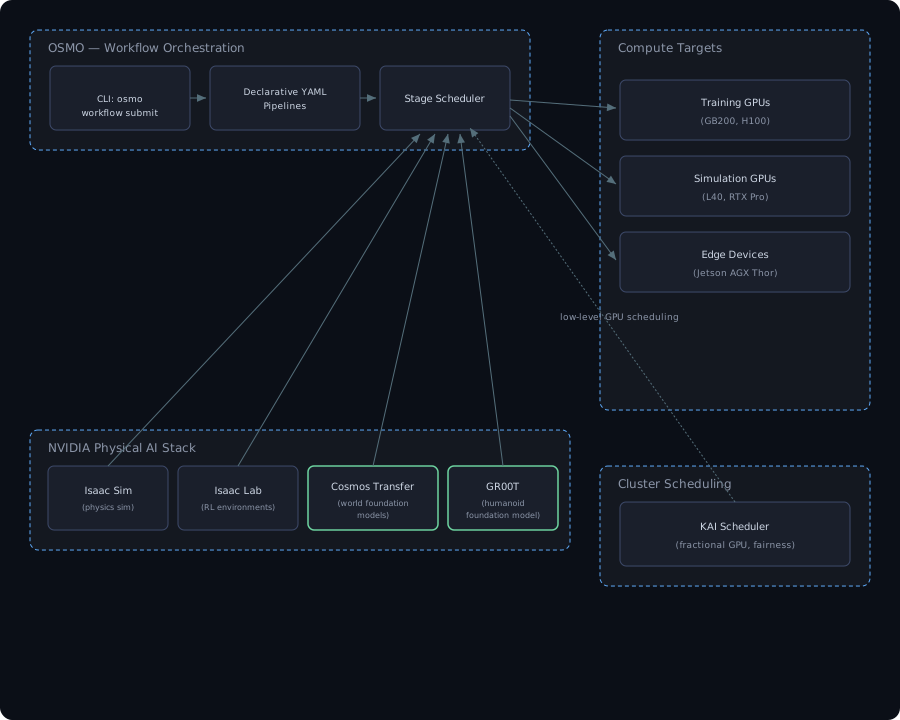
Editable Mermaid source: images/nvidia-osmo-physical-ai-stack.mermaid.md
Canonical pipeline: Isaac Sim (3D reconstruction) → MobilityGen (synthetic data) → Cosmos Transfer (augmentation) → Training → SIL/HIL evaluation — all as a single OSMO YAML workflow.
KAI Scheduler relationship: KAI (open-sourced from Run:ai, Apache 2.0) handles low-level GPU scheduling (fractional sharing, fairness, queuing) within a single K8s cluster. OSMO operates at the workflow/pipeline level across multiple clusters. They are complementary — OSMO could use KAI as its underlying scheduler.
Licensing and Pricing
- Apache 2.0 — fully open source, no cost
- No commercial tier or enterprise pricing
- Adopted by Hexagon Robotics; integrated into Microsoft Azure Robotics Accelerator
- Infrastructure costs (K8s clusters, GPUs, cloud) are on the user
Auraison vs OSMO: Detailed Comparison
| Dimension | OSMO | Auraison |
|---|---|---|
| Architecture | Pipeline executor (static DAGs) | Agent-driven orchestrator (dynamic composition) |
| Task specification | YAML workflow definitions | Natural language / multimodal intent |
| Intelligence | None — executes what you define | LLM agents reason about capability selection and placement |
| Compute scheduling | Stage-level placement across heterogeneous clusters | Agent-level edge-cloud co-execution with latency awareness |
| Experiment tracking | None | W&B integration |
| Data management | Content-addressable dedup (S3/Azure) | DuckDB + DuckLake lakehouse with digital twins |
| Model serving | Out of scope (produces artifacts only) | vLLM / Ray Serve |
| World models | None (Cosmos is a pipeline stage, not integrated reasoning) | Cosmos Predict2 → Transfer2.5 → Reason2 (feasibility loop) |
| Self-healing | None — failed stages fail | Agent-driven recovery and replanning |
| Deployment | Cloud K8s (EKS, AKS, GKE, on-prem) | Self-hosted Proxmox K8s (air-gap capable) |
| Community | 111 stars, 17 contributors | Pre-1.0 |
| License | Apache 2.0 | TBD |
Where OSMO is better
- Production maturity for static pipeline orchestration — battle-tested inside NVIDIA
- Multi-cloud support — native EKS/AKS/GKE deployment
- NVLink topology awareness — understands GPU interconnect for training placement
- NVIDIA ecosystem integration — first-class Isaac Sim, Isaac Lab, GR00T support
Where Auraison is better
- Dynamic orchestration — agents compose capabilities at runtime, not in advance
- Intent-driven — users describe outcomes, not pipelines
- Full lifecycle — from task specification through execution, monitoring, and retraining
- Data plane — structured lakehouse with digital twins vs simple object storage
- Self-hosted / air-gap — critical for defense and classified environments
Integration Opportunity
OSMO and Auraison operate at different abstraction levels and are complementary:
Auraison Control Plane (intent → agent composition → placement)
    ↓ dispatches training/simulation stages to
OSMO (YAML pipeline execution across GPU clusters)
    ↓ uses
KAI Scheduler (fractional GPU scheduling within a cluster)
Auraison could use OSMO as a compute backend for training pipeline stages while providing the intelligent orchestration, experiment tracking, and agent supervision that OSMO lacks.
Key Limitations of OSMO
- Not a simulator or training framework — orchestrates them but does not replace Isaac Sim, PyTorch
- No production deployment — produces trained artifacts but deployment to robots is out of scope
- No MLOps features — no experiment dashboards, artifact registry, or pipelines-as-code UI
- Kubernetes required — no standalone mode; requires pre-provisioned K8s clusters
- 16-month release gap — v6.0 stable is from Nov 2024; v6.2 still in RC
- Small community — 111 stars, 19 forks suggests limited adoption outside NVIDIA ecosystem
- Overkill for single-cluster — if you only have one GPU cluster, Argo Workflows or KubeFlow Pipelines are simpler
Watch Items
- v6.2 "AI Agentic Skills" — if OSMO adds intelligent agent capabilities, it moves from complementary to competitive. Currently only in RC with no documentation on what "agentic" means in practice.
- NVIDIA vertical integration — if NVIDIA bundles OSMO + Isaac + Cosmos + GR00T into a turnkey product, it could squeeze out third-party orchestrators.
- KAI Scheduler maturity — as KAI matures, the combination of KAI (scheduling) + OSMO (pipelines) + Isaac (simulation) could become a formidable open-source stack that reduces the need for Auraison's scheduling intelligence.