Competitive Landscape
Date: 2026-03-16 | Issue: auraison-5mq
Market Map
The physical AI platform market is fragmenting into four quadrants. No single player covers all four.
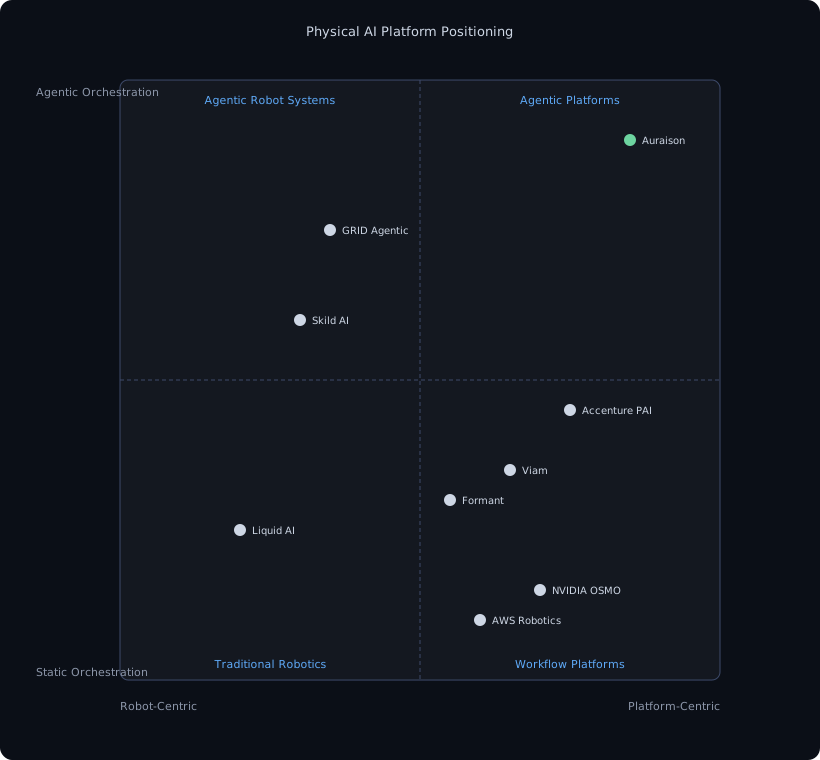
Editable Mermaid source: images/landscape-platform-positioning.mermaid.md
Competitor Profiles
Viam
What it is: Cloud robotics platform that abstracts hardware into unified APIs (Python, Go, TypeScript SDKs). Founded by MongoDB co-founder Eliot Horowitz.
| Attribute | Detail |
|---|---|
| Funding | 30M Series C (Mar 2025, Union Square Ventures) |
| Pricing | Consumption-based. Free tier (25K monthly gRPC calls). No per-device fees. Enterprise custom. |
| Customers | Sbarro, Transmutex, Appetronix, CompScience (QSR, climate tech, marine, nuclear, manufacturing) |
Strengths:
- Language-agnostic SDK lowers barrier for software engineers (not just roboticists)
- Hardware-agnostic — modular registry of pre-built drivers and ML models
- Built-in motion control, CV, fleet management, OTA updates, canary testing/rollback
- MongoDB pedigree brings enterprise credibility
Weaknesses:
- No agentic orchestration — manual pipeline construction
- No world models, no simulation integration
- No experiment tracking or data lakehouse
- Competing against free ROS ecosystem on one side and hyperscaler offerings on the other
vs Auraison: Viam is a developer platform (hardware abstraction + fleet management). Auraison is an orchestration platform (intent → agent composition → execution). Complementary at different layers — Viam could be the hardware abstraction layer under Auraison's user plane, similar to how GRID Classic hardware could sit under Auraison.
Formant
What it is: Cloud robotics platform for fleet management, teleoperation, and observability. AI engine "F3" adds voice commands and predictive insights.
| Attribute | Detail |
|---|---|
| Funding | 21M Series B (Oct 2023, BMW i Ventures). Investors: Intel Capital, Ericsson, Goodyear Ventures |
| Pricing | SaaS subscription. Free tier for individual roboticists. Enterprise pricing undisclosed. |
| Claims | 60% reduction in downtime, 8x utilization increase, 72% faster rollouts |
Strengths:
- Strategic investors from automotive (BMW), telecom (Ericsson), fleet (Goodyear) — real industry pull
- Focused exclusively on fleet operations — deep expertise in observability and incident management
- Free tier creates adoption funnel
- Mission control, performance analytics, workflow automation
Weaknesses:
- Fleet ops only — no pipeline synthesis, no training, no agent composition
- Smaller funding ($45M) limits R&D runway
- No funding round since Oct 2023 — potential growth signal
- No publicly disclosed revenue or customer count
vs Auraison: Formant is an operations platform (fleet observability + teleoperation). Auraison is an orchestration platform that includes operations as one capability among many. Formant's fleet management features could complement Auraison for large-scale deployments.
AWS Robotics / Physical AI
What it is: A reference architecture (not a product) combining SageMaker, IoT Greengrass, EC2, and S3 for robotics AI workflows. AWS RoboMaker was deprecated (end-of-support Sep 2025).
| Attribute | Detail |
|---|---|
| Pricing | Pay-as-you-go for individual AWS services. No bundled robotics pricing. |
| Status | Reference guidance only. RoboMaker deprecated. |
Strengths:
- Massive infrastructure scale and existing enterprise relationships
- Deep integration across ML training (SageMaker), edge (Greengrass), storage (S3)
- NVIDIA partnership for simulation
- Marketplace ecosystem
Weaknesses:
- Not a product — requires significant integration work to assemble
- RoboMaker deprecation signals AWS may be de-prioritizing robotics-specific tooling
- No robotics-specific abstractions (no SDK for motor control, no fleet management UI)
- Vendor lock-in concerns
vs Auraison: AWS provides infrastructure primitives. Auraison provides the intelligent orchestration layer that assembles those primitives into working systems. AWS's de-prioritization of RoboMaker creates a vacuum that Auraison can fill — and listing on AWS Marketplace lets enterprise customers purchase Auraison using committed cloud spend.
Accenture Physical AI Orchestrator
What it is: An enterprise consulting engagement (launched Oct 2025 at GTC DC) combining NVIDIA Omniverse, Metropolis, and Accenture AI Refinery agents for manufacturing digital twins.
| Attribute | Detail |
|---|---|
| Pricing | Project-based consulting, likely $1M+ engagements |
| Results | 20% throughput improvement, 15% CapEx savings (consumer goods manufacturer) |
| Customers | Belden, life sciences, consumer goods |
Strengths:
- Deep NVIDIA partnership (Omniverse, Metropolis)
- Existing Fortune 500 manufacturing relationships
- Proven results with named customers
- Massive consulting delivery capacity (~$220B market cap company)
Weaknesses:
- Not a platform — it is a consulting service requiring Accenture engagement
- Not self-service; very high cost of entry
- Focused exclusively on manufacturing/warehouse
- Dependent on NVIDIA Omniverse ecosystem
vs Auraison: Accenture sells transformation projects. Auraison sells a self-service platform. Different market segments: Accenture targets Fortune 500 manufacturers with $1M+ budgets; Auraison targets mid-market and defense with self-hosted deployments. Accenture's naming of the category ("Physical AI Orchestrator") validates the market.
Skild AI
What it is: Universal robotics foundation model ("Skild Brain") — a single model controlling any robot form factor without prior knowledge of body form.
| Attribute | Detail |
|---|---|
| Funding | ~1.4B Series C (Jan 2026, SoftBank). $14B valuation. |
| Revenue | ~$30M run rate (growing rapidly) |
| Investors | SoftBank, NVIDIA (NVentures), Bezos, Lightspeed, Sequoia, LG, Samsung, Schneider Electric |
Strengths:
- Largest funding in robotics AI
- Foundation model approach — winner-take-most dynamics if it works
- Omni-bodied: adapts to limb loss, jammed wheels, payload changes, new bodies without retraining
- Revenue traction ($30M in months)
- Carnegie Mellon pedigree
Weaknesses:
- 30M revenue (>450x multiple) — extremely aggressive
- Foundation model generality claims hard to independently verify
- Competing against specialized solutions that may outperform on specific tasks
- Massive capital requirements for training
- No publicly named production customers at scale
vs Auraison: Skild is building one model for all robots. Auraison orchestrates many specialized models across heterogeneous systems. Complementary: Skild Brain could be one of the models Auraison's control plane deploys and supervises, alongside Cosmos, VLAs, and task-specific perception models.
General Robotics GRID
See dedicated analysis. Key takeaway: GRID Agentic is the closest architectural competitor (MCP skills, LLM orchestration, multi-agent decomposition), but GRID Classic hardware is a potential integration target for defense applications.
Competitive Matrix
| Capability | Auraison | NVIDIA OSMO | Viam | Formant | AWS | Accenture | Skild AI | GRID | Liquid AI |
|---|---|---|---|---|---|---|---|---|---|
| Intent-driven orchestration | Yes | No | No | No | No | Partial | No | Partial | No |
| Dynamic agent composition | Yes | No | No | No | No | No | No | Yes | No |
| Edge-cloud co-execution | Yes | Training only | Fleet only | Fleet only | Manual | Manufacturing | Edge only | Cloud only | Edge only |
| World models (Cosmos) | Yes | Pipeline stage | No | No | No | Via Omniverse | No | No | No |
| Digital twins | Yes | No | No | No | Via IoT | Via Omniverse | No | No | No |
| Experiment tracking | W&B | No | No | No | SageMaker | No | No | No | No |
| Model serving | vLLM/Ray | No | Built-in ML | No | SageMaker | No | Skild Brain | Cloud GPU | LEAP / Bedrock |
| Data lakehouse | DuckDB | Object store | Cloud data | Telemetry | S3 | Omniverse | No | Vector DB | No |
| Self-hosted / air-gap | Yes | On-prem K8s | No | No | No | No | No | No | On-device |
| Hardware abstraction | ROS 2 | No | Yes | No | Greengrass | No | Yes | Yes | NPU/CPU |
| Fleet management | Planned | No | Yes | Yes | Greengrass | No | No | No | No |
| Open source | Partial | Yes | Partial | No | N/A | No | No | Partial | LFM License |
| Self-healing | Yes | No | OTA rollback | Alerting | No | No | Adapts | No | No |
Market Dynamics
Capital flows
| Company | Latest round | Amount | Valuation | Date |
|---|---|---|---|---|
| Skild AI | Series C | $1.4B | $14B | Jan 2026 |
| Liquid AI | Series A | $250M | $2B+ | Dec 2024 |
| Viam | Series C | $30M | Undisclosed | Mar 2025 |
| Formant | Series B | $21M | Undisclosed | Oct 2023 |
| NVIDIA OSMO | Open source | N/A | N/A | Nov 2024 |
| Accenture | Corporate | N/A | ~$220B (public) | Oct 2025 |
AI firms captured 61% of all global VC in 2025 (113B (OECD). Physical AI is a named category with accelerating investment.
Signals
- AWS RoboMaker deprecated (Sep 2025) — vacuum in cloud robotics tooling
- Accenture names the category ("Physical AI Orchestrator") — enterprise demand validated
- NVIDIA open-sources KAI + OSMO — commoditizing the scheduling layer, pushing value up to orchestration
- Skild AI's $14B valuation — investors betting on foundation models for physical AI; orchestration is the complementary layer
Auraison's positioning
Auraison occupies a unique quadrant: platform-centric + agentic orchestration. No competitor combines intent-driven agent composition with edge-cloud co-execution, world models, a structured data lakehouse, and self-hosted deployment.
The nearest competitor by architecture is GRID Agentic, but GRID is robot-centric (optimized for individual robot tasks) while Auraison is platform-centric (optimized for distributed multi-device systems).
Sources
- Viam: Fortune, Pricing
- Formant: SiliconANGLE
- AWS Physical AI: Reference Architecture
- Accenture: Newsroom, AI Magazine
- Skild AI: TechCrunch, BusinessWire
- OECD: VC in AI 2025