Competitive Analysis: General Robotics GRID vs Auraison
Date: 2026-03-11 Issue: auraison-k3m Sources:
- Agentic Architectures for Robotics: Design Principles and Model Abilities (General Robotics, Oct 2025)
- Open GRID Documentation
- Prototyping Counter-UAS with GRID
Executive summary
General Robotics' GRID is the closest publicly documented competitor to Auraison's architectural vision. Both platforms argue that modular skill composition via LLM orchestration is the correct paradigm for general-purpose robotics, rejecting monolithic VLA models. Both adopt Zenoh, cloud-first GPU execution, and simulation-first development.
However, GRID has two identities that must be analyzed separately:
- GRID Classic — the pre-2025 hardware/middleware stack used in defense, counter-UAS, and tele-operation. A robot-centric embedded system architecture (hardware abstraction → control → mission application → operator interface). No AI agents, no cloud, no datasets.
- GRID Agentic — the Oct 2025 paper's vision: cloud-hosted AI skills, MCP protocol, LLM-driven composition, observational memory. A platform-centric architecture closer to Auraison's ambitions.
The architectures diverge on three critical axes: (1) skill protocol — GRID uses MCP, Auraison uses Zenoh queryables; (2) world model — Auraison has NVIDIA Cosmos, GRID has none; (3) data persistence — Auraison has a structured lakehouse with digital twins, GRID uses vector DB for observational memory. These differences reflect fundamentally different bets: GRID bets on LLM reasoning as sufficient for physical intelligence; Auraison bets on learned world models (Cosmos) and persistent structured state (twins) as necessary complements.
For counter-uas, GRID Classic hardware may sit under Auraison as the robot execution layer, while GRID Agentic is the architectural competitor to monitor.
1. What GRID is
GRID (General Robot Intelligence Development) is a web-based platform for developing, training, validating, and deploying "intelligent skills" for heterogeneous robots. The Oct 2025 paper formalizes the architecture around three pillars:
Pillar 1 — Skills as modular, accessible units
AI models and robotics routines (perception, planning, control) are wrapped as MCP servers with typed inputs/outputs, documentation, and usage examples. Skills are hosted on cloud GPUs as auto-scalable services. The paper uses OWLv2, Grounded SAM2, ZoeDepth, MIDAS, Moondream, Contact Graspnet, and DreamControl as example skills.
Key design choice: skills are cloud-hosted REST/WebSocket services, not on-robot. This enables elastic scaling and concurrent multi-model execution but introduces network latency.
Pillar 2 — Unified Robot API (form-factor abstraction)
Instead of per-robot SDKs, GRID defines canonical primitives per form factor:
- Arms:
robot.grasp(pose),robot.moveToPose(position, orientation) - Mobile robots:
robot.move_to(pose),robot.rotate(orientation) - Drones: velocity control, waypoint navigation, camera access
Tested robots: UR5e, Trossen WidowX, ModalAI Starling 2 Max, Unitree Go2, Unitree G1. Simulation (AirGen, Isaac Sim) exposes the same API, enabling sim-to-real transfer.
Pillar 3 — LLM-driven composition
An orchestrator agent (primarily GPT-4.1/5, LLM-agnostic) composes skills and robot APIs into executable programs. Two modes:
- Tool invocation: sequential/parallel MCP tool calls for well-defined skill chains
- Code generation: synthesize Python programs for complex logic, state management, novel control flows
Specialized sub-agents: planner (structured plans with citations), coder (plans → executable code), critic (validates outputs, proposes retries). All outputs are schema-constrained for traceability.
Memory system
Two complementary axes:
- Observational memory: VLM captions + dense image embeddings stored in a vector database. Enables retrospective queries ("where did you see the OXG box?") and multi-modal retrieval.
- Operational memory: execution traces, generated code, external domain knowledge (e.g., FAA Part 107 regulations embedded for drone mission planning). Supports reflection and continual improvement.
Simulation as sandbox
Simulation (AirGen) is a first-class component. Agents can launch simulations, configure environments, execute behaviors, and iterate — using simulation as a generative sandbox for skill development, not just validation.
2. Architecture comparison
Structural mapping
| GRID concept | Auraison equivalent | Alignment |
|---|---|---|
| AI Skills (MCP servers) | User-plane workloads (Ray Jobs/Serve) | Similar intent, different protocol |
| Unified Robot API | ros2_control + lerobot-ros + ros-mcp-server | GRID is more abstract; Auraison is ROS-native |
| LLM Orchestrator (GPT-4.1/5) | Claude Code agents (claude -p subprocesses) | Different LLM, different execution model |
| Planner / Coder / Critic agents | Single-agent subprocesses (NotebookAgent, TwinAgent, etc.) | GRID has richer agent decomposition |
| Observational memory (vector DB) | Digital twins (Parquet lakehouse) | Different modalities — embeddings vs structured state |
| Operational memory (traces + domain knowledge) | AgentOps traces + data-plane lakehouse | Similar intent, Auraison more structured |
| AirGen / Isaac Sim | Gazebo Harmonic / Unreal Engine 5 | Comparable |
| Cloud GPU skill hosting | KubeRay on Proxmox K8s | GRID is public cloud; Auraison is self-hosted |
| (none) | Cosmos world models (Predict2, Transfer2.5, Reason2) | Auraison advantage |
| (none) | Digital twin reconciliation (predicted vs observed) | Auraison advantage |
| (none) | Four-plane separation (failure isolation) | Auraison advantage |
| MCP skill protocol | Zenoh queryable | Different bets (see §3) |
Plane mapping
GRID is a monolithic web platform — skills, orchestration, memory, and simulation are all co-located in a single service. There is no explicit separation of concerns analogous to Auraison's four planes. In Auraison terms:
GRID "Skills"         → Auraison user plane (execution)
GRID "Agent Layer"    → Auraison control plane (orchestration)
GRID "Memory System"  → Auraison data plane (persistence)
GRID (none)           → Auraison management plane (governance)
GRID lacks explicit failure isolation between these concerns. A skill failure could cascade to the orchestrator. Auraison's plane separation is a deliberate design choice for production resilience — user plane failures do not cascade to the control plane.
3. Critical divergences
3.1 Skill protocol: MCP vs Zenoh queryable
GRID's choice (MCP):
- Natural fit for LLM tool calling — typed schemas, documentation, usage examples
- Each skill is an MCP server; the agent discovers and invokes via standard MCP protocol
- 30+ pre-integrated models in the GRID library
- REST/WebSocket transport underneath
Auraison's choice (Zenoh queryable):
- Optimized for robotics latency (microseconds vs milliseconds)
- Native DDS bridge — zero-code integration with ROS 2 nodes
- Pub/sub + query semantics (not just request/response)
- Multi-consumer: multiple nodes can subscribe to inference results
Assessment: GRID's MCP choice is better for LLM ergonomics — the agent reasons more naturally about typed tools than about Zenoh key-expressions. Auraison's Zenoh choice is better for real-time robot control — the 13μs wire latency matters for closed-loop control at 100Hz+.
Implication for Auraison: Consider exposing Zenoh queryables also as MCP tools for
control-plane agents. This is exactly what ros-mcp-server already does for turtlebot-maze
— it wraps ROS 2 topics as MCP tools. The pattern could be generalized: a zenoh-mcp-bridge
that exposes Zenoh queryables as MCP tools, giving control-plane agents GRID-like ergonomics
while preserving Zenoh's real-time performance for the user plane.
3.2 World models: Cosmos vs none
GRID has no world model layer. Agents reason about the physical world purely through perception skills (depth estimation, segmentation, VQA) and LLM reasoning. There is no mechanism to predict future states before acting.
Auraison's Cosmos stack provides:
- Cosmos-Predict2: current frame + proposed action → predicted trajectory video
- Cosmos-Transfer2.5: synthetic → photorealistic (sim2real augmentation)
- Cosmos-Reason2: physics-grounded feasibility evaluation (go/no-go before execution)
This is a fundamental architectural difference. GRID's approach works for discrete, sequential tasks (pick this, place that) where the LLM can reason step-by-step. It struggles with continuous control and anticipatory reasoning — predicting what will happen if the robot takes a specific action in a specific physical context.
The GRID paper's own chess example illustrates the gap: they needed to integrate Stockfish (a domain-specific engine) because LLM reasoning alone was insufficient for tactical evaluation. In physical domains, Cosmos fills this role — it provides physics-grounded predictions that LLM text reasoning cannot.
Assessment: Auraison's world model layer is a significant advantage for safety-critical and continuous-control applications. GRID's approach is simpler and works well for perception-reasoning-action chains with discrete steps.
3.3 Data persistence: lakehouse vs vector DB
GRID's memory:
- Observational: VLM captions + image embeddings in vector DB (similarity search)
- Operational: execution traces, domain knowledge (FAA regs)
- No structured schema; retrieval is embedding-based
Auraison's memory:
- Digital twins: 7 Parquet tables (assets, state_snapshots, sensor_readings, events, twin_jobs, annotations, urdf_assets) + firmware_versions
- Structured, queryable, versioned
- Predicted vs observed state reconciliation
- Historical replay capability
Assessment: These are complementary, not competing.
GRID's embedding-based memory excels at retrieval ("have you seen this object before?", "what does the FAA say about this airspace?"). Auraison's lakehouse excels at analytics ("plot the robot's trajectory over the last 10 jobs", "which joint exceeded torque limits most frequently?", "compare predicted vs actual paths").
Implication for Auraison: The data plane should add an embeddings store (v2, already
planned in four-plane.md) to complement the structured lakehouse. VLM captions +
image embeddings over twin state snapshots would give Auraison both GRID-style retrieval
and structured analytics.
3.4 VLA philosophy: composition vs learned policies
GRID: No VLA models. All behavior is composed at runtime by the LLM from perception + planning + control skills. The LLM is the policy — it decides what to do based on perception outputs and user instructions. Code synthesis bridges the gap between high-level reasoning and low-level control.
Auraison: LeRobot VLA models (ACT → Pi0 → GR00T) provide learned, end-to-end visuomotor policies. The LLM orchestrates when and how to deploy these policies, but the policies themselves are neural networks trained on demonstration data.
Assessment: GRID's composition approach is more interpretable and debuggable — every action is an explicit tool call or line of generated code. Auraison's VLA approach is more capable for manipulation — learned policies can handle continuous, high-frequency control that LLM text reasoning cannot produce.
The GRID paper's ablation study (Table 3) is revealing: without skills and APIs, all LLM agents (Claude Code, Codex, Copilot) failed to generate working pick-and-place code. This validates that LLM reasoning alone is insufficient — but GRID solves it with cloud-hosted skill services, while Auraison solves it with learned VLA policies. Both are valid; they optimize for different properties (interpretability vs capability).
4. What Auraison should learn from GRID
4.1 MCP as the skill discovery protocol
GRID's use of MCP to expose all skills (perception, planning, control) to the LLM agent is
elegant and well-validated. Auraison already uses this pattern in one place —
ros-mcp-server for turtlebot-maze. The pattern should be generalized:
- Each user-plane capability (VLA inference, Cosmos prediction, depth estimation) should be discoverable as an MCP tool by control-plane agents
- A
zenoh-mcp-bridgecould auto-expose Zenoh queryables as MCP tools - This gives control-plane agents a uniform skill catalog without sacrificing Zenoh's real-time performance for user-plane communication
4.2 Unified Robot API abstraction
GRID's form-factor Robot API (robot.grasp(), robot.move_to()) is cleaner than
Auraison's current per-robot approach. Auraison has lerobot-ros (AR4), ros-mcp-server
(TurtleBot), and will need drone APIs (counter-uas). These should converge on a
form-factor abstraction:
ArmAPI:    grasp, moveToPose, moveToJoint, home, calibrate
MobileAPI: move_to, rotate, navigate_to, stop
DroneAPI:  takeoff, land, goto_waypoint, set_velocity, get_image
4.3 Multi-agent decomposition
GRID's orchestrator/planner/coder/critic pattern is more sophisticated than Auraison's current single-agent subprocesses. Auraison should consider decomposing complex agent tasks (especially TwinAgent operations that involve perception + reasoning + data writes) into specialized sub-agents. The AgentOps subsystem is the right place for this.
4.4 Observational memory
GRID's dual-embedding memory (VLM captions + image embeddings in vector DB) is a compelling complement to Auraison's structured twins. Adding this as a layer on top of twin state_snapshots would enable natural-language queries over robot history: "When was the last time the gripper dropped something?" → vector search over event captions → return timestamp + twin state at that moment.
4.5 Domain knowledge grounding
GRID's FAA Part 107 example — embedding regulatory documents into operational memory and using them to gate drone missions — is directly applicable to counter-uas. Auraison should adopt this pattern: embed relevant standards (DO-178C for avionics, MIL-STD-882 for safety, site-specific operational rules) into the data plane and make them queryable by control-plane agents via RAG.
5. Where Auraison has advantages GRID lacks
5.1 Physics-grounded world models
The Cosmos Predict → Transfer → Reason → Execute loop provides anticipatory reasoning that GRID cannot match. GRID agents act and observe; Auraison agents predict, evaluate feasibility, then act. This is critical for safety-critical applications.
5.2 Persistent structured world state
Digital twins with 7 Parquet tables, reconciliation, predicted vs observed comparison, and historical replay are a fundamentally richer persistence model than GRID's vector DB. Auraison can answer causal questions ("why did the robot fail at timestamp T?") that GRID cannot.
5.3 Failure isolation (four-plane architecture)
GRID is a monolithic web platform. Auraison's four-plane architecture provides explicit failure boundaries: user plane failures halt the robot but the control plane continues; control plane outages don't stop running agents. This matters for production deployment.
5.4 Self-hosted infrastructure
Auraison runs on Proxmox K8s — no cloud vendor lock-in, no data exfiltration, full control over GPU allocation. GRID is cloud-hosted, which limits deployment in classified or air-gapped environments (directly relevant for counter-uas).
5.5 Learned visuomotor policies
LeRobot VLA models provide continuous-control capabilities that LLM-composed skill chains cannot replicate. For high-frequency manipulation (100Hz+ joint control), learned policies are necessary.
6. GRID platform capabilities (Open GRID)
From the platform documentation:
Simulation: AirGen (drones, cars, legged robots with cameras, GPS, sensors) and Isaac Sim (RL workflows, teleoperation including VR, multi-robot scenarios).
AI model library (30+ pre-integrated):
- Depth: DepthAnything, MIDAS, ZoeDepth, Metric3D, Sapiens Depth
- Detection: Grounding DINO, OWLv2, RT-DETR
- Segmentation: SAM 2, Grounded SAM, CLIPSeg, OneFormer
- Navigation: Visual Servoing, Object Inspection
- Tracking: CoTracker, UniMatch
- VLMs: LLaVA variants, MiniCPM, Molmo
Robot support: UR5e, IsaacArm, Go2, AirGenQuad, G1 humanoid, wheeled platforms. End-effectors: grippers, suction cups.
Integration: ROS/ROS2, PX4 autopilot, Zenoh middleware, camera calibration, custom clients (HTTP, MCP, Nexus protocols).
Counter-UAS relevance: GRID has demonstrated drone control (ModalAI Starling 2 Max),
aerial visual tracking, and regulatory knowledge grounding (FAA Part 107). This is directly
relevant to aegean-ai/counter-uas.
7. Protocol benchmarks from the paper
The paper provides valuable empirical data on transport protocols that validates Auraison's Zenoh choice:
Inference latency (640x480 JPG input)
| GPU | Model | HTTP RTT (ms) | WebSocket RTT (ms) |
|---|---|---|---|
| H100 | ZoeDepth | 172 | 136 |
| H100 | OWLv2 | 230 | 216 |
| H100 | OneFormer | 120 | 100 |
| L4 | ZoeDepth | 224 | 184 |
| T4 | ZoeDepth | 290 | 258 |
Control command latency (ms)
| Protocol | LAN | LAN (adverse) | WAN (US West) | WAN (US East) |
|---|---|---|---|---|
| REST | 2.55 | 7.72 | 23.8 | 74.8 |
| WebSocket | 1.37 | 4.88 | 15.1 | 36.3 |
| gRPC | 3.09 | 6.25 | 11.3 | 36.1 |
| ZeroMQ | 1.18 | 3.77 | 12.2 | 38.9 |
| Zenoh (peer) | 1.26 | 2.70 | 11.9 | 35.9 |
| Zenoh (router) | 1.29 | 2.90 | 12.5 | 36.0 |
Key finding: Zenoh provides the best balance of low latency and graceful degradation under adverse conditions (jitter, packet loss). WebRTC is best for high-resolution video streaming. REST is worst in all scenarios. This directly validates Auraison's Zenoh choice for control channels and suggests adding WebRTC for camera streaming.
8. GRID's dual identity: hardware stack vs agentic platform
General Robotics has two product faces that must be evaluated separately.
GRID Classic — the defense hardware stack
The established GRID product is a robotic middleware + hardware control stack used in defense, security, and industrial tele-operation (weapon stations, counter-UAS, manipulation systems). Its architecture is traditional embedded robotics — five stacked functional layers in a single runtime:
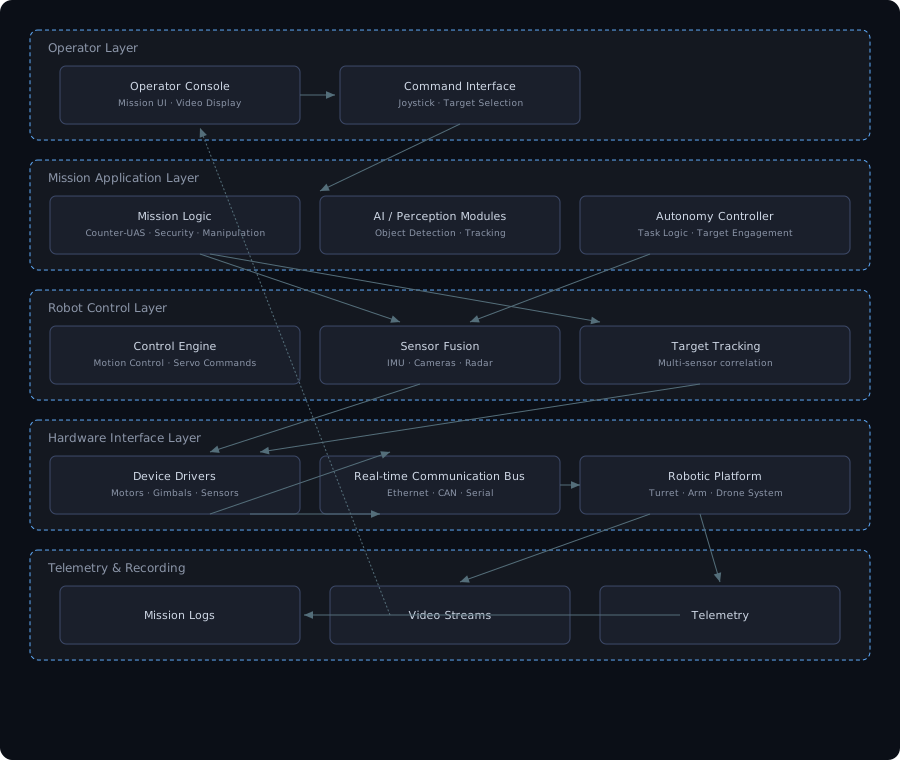
Editable Mermaid source: images/general-robotics-grid-classic-stack.mermaid.md
Everything runs in a single integrated runtime — no plane separation, no distributed compute, no AI agents. This is a robot system architecture, not a platform architecture.
The control loop is designed for deterministic timing, hardware safety, and operator override:
Sensors → Fusion → Tracking → Control → Actuators
             ↑                     ↑
        operator override    safety limits
Mapping GRID Classic to Auraison planes:
| Auraison plane | GRID Classic equivalent | Coverage |
|---|---|---|
| User plane | Robot control, perception, weapon/manipulation loops | Strong — this is GRID's core |
| Control plane | Mission orchestration, operator commands | Partial — embedded logic, not agent scheduling |
| Data plane | Telemetry logs, mission recordings (file-based, local) | Minimal — no lakehouse, no ML datasets |
| Management plane | Configuration GUIs, operator consoles | Weak — operational interfaces, not governance |
GRID Classic compresses all four planes into a single runtime stack. This is typical for embedded robotic systems and is a fundamentally different abstraction level.
GRID Agentic — the Oct 2025 paper
The paper represents a strategic pivot: GRID evolving from a robot hardware stack into an LLM-driven agentic robotics platform with cloud-hosted AI skills, MCP protocol, multi-agent composition, and memory systems. This is the version analyzed in detail in §1–§7 above.
The pivot is significant but incomplete — the paper's experiments are qualitative demos (UR5e pick-and-place, Go2 navigation, drone tracking, chess), not production deployments. The gap between "GRID Classic deployed on GRID hardware in counter-UAS operations" and "GRID Agentic running GPT-5 on cloud GPUs" is substantial.
Strengths of GRID Classic that Auraison lacks
-
Deterministic control stack: GRID Classic is optimized for low-latency, mission-reliable, deterministic behavior. Auraison's user plane achieves this via KubeRay + ROS 2, but has not been hardened for defense-grade operations.
-
Hardware integration maturity: Hardened drivers, safety mechanisms, certified components for defense platforms. Auraison relies on ROS 2 + simulation + containerized systems — research-grade, not defense-grade.
-
Degraded-network operation: GRID Classic is designed for hostile environments, degraded networks, operator-in-the-loop systems. Auraison assumes reliable cluster networking (Proxmox K8s LAN).
-
Waveshare General Driver for Robots: GRID has a hardware abstraction board that provides a standardized physical interface to diverse robot platforms — motor drivers, sensor connectors, communication buses. Auraison has no hardware abstraction at this level.
The key mental model
| System | Analogy |
|---|---|
| GRID Classic | ROS stack appliance (robot-centric) |
| GRID Agentic | GRID Classic + cloud AI skills + LLM orchestration |
| Auraison | Kubernetes for robotics + AI agents (platform-centric) |
GRID is robot-centric — the robot is the primary system, software serves it. Auraison is platform-centric — robots are one workload among many, the platform orchestrates across applications.
Strategic integration: counter-uas
Side-by-side structural comparison
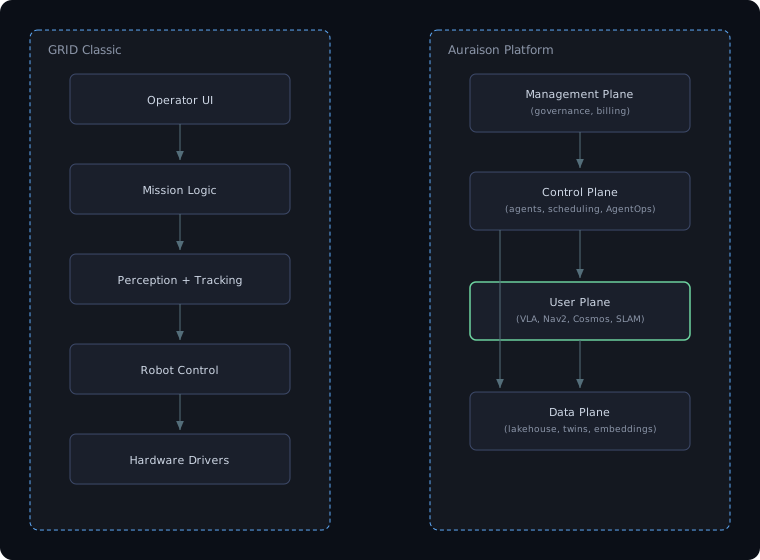
Editable Mermaid source: images/general-robotics-side-by-side.mermaid.md
For counter-uas, the natural architecture is Auraison as AI orchestration platform, GRID Classic as robot hardware execution layer:
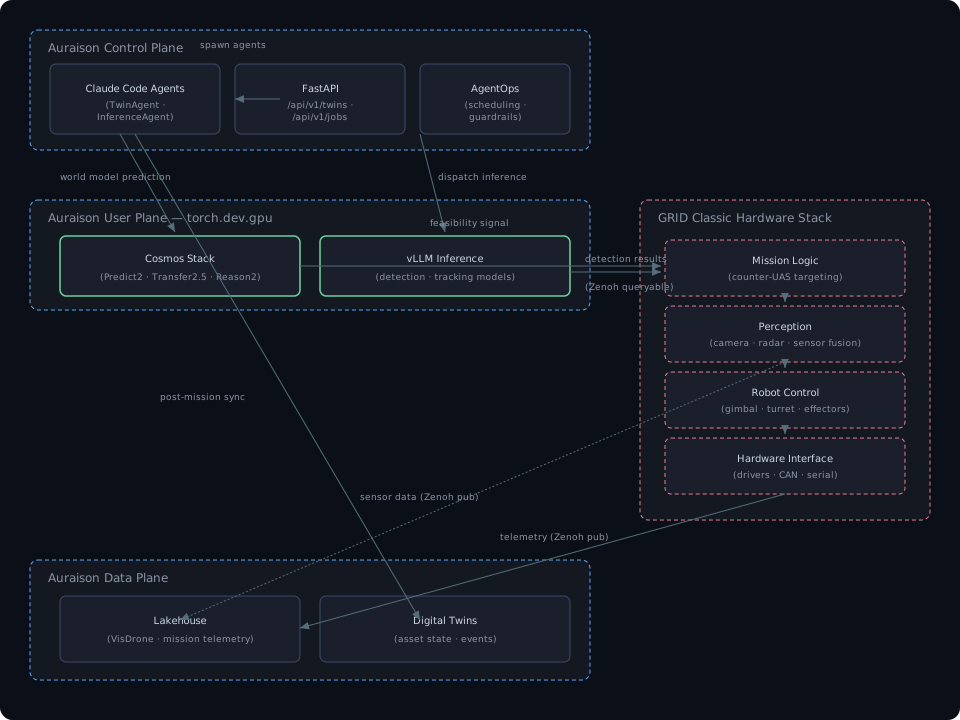
Editable Mermaid source: images/general-robotics-counter-uas-integration.mermaid.md
This preserves GRID Classic's defense-grade hardware maturity while adding Auraison's AI orchestration, dataset lifecycle, digital twins, and Cosmos world models. Neither system alone covers both needs — they are complementary at different abstraction levels.
The risk is if GRID Agentic matures and General Robotics offers the full stack (hardware + cloud AI) as a vertically integrated product, making Auraison redundant for GRID hardware customers. This is monitored in risk item 5.
9. Risks and watch items
-
GRID as commercial competitor: General Robotics is building a SaaS platform. If counter-uas uses GRID integration, there is vendor dependency risk. Auraison's self-hosted architecture mitigates this.
-
MCP becoming the standard: If MCP becomes the dominant protocol for robot skill exposure (GRID is a strong signal), Auraison's Zenoh-only approach for the user plane may become a friction point for third-party skill integration. The
zenoh-mcp-bridgerecommendation (§4.1) addresses this. -
GRID's model library: 30+ pre-integrated perception models is a significant developer experience advantage. Auraison should curate a comparable model catalog, leveraging the vLLM + Zenoh queryable pattern to make model integration frictionless.
-
Agent ablation results: GRID's Table 3 shows that Claude Code solved pick-and-place in 2 attempts with full GRID support, but failed without skills/APIs. This validates our architecture — agents need structured skill access — but also highlights that Claude's robotics code generation trails Codex (1 attempt) with the right scaffolding.
-
Vertical integration risk: If GRID Agentic matures and General Robotics offers hardware + cloud AI as a single product, counter-uas customers may prefer the integrated stack over Auraison + GRID Classic. Auraison's defense: (a) Cosmos world models (GRID has none), (b) self-hosted infrastructure (no cloud dependency in classified environments), (c) structured data plane for ML dataset lifecycle.
10. Recommendations
| # | Action | Priority | Auraison component |
|---|---|---|---|
| R1 | Build zenoh-mcp-bridge: auto-expose Zenoh queryables as MCP tools for control-plane agents | P1 | Control plane |
| R2 | Define form-factor Robot API abstraction (ArmAPI, MobileAPI, DroneAPI) | P2 | User plane |
| R3 | Add embeddings store to data plane for observational memory (v2) | P2 | Data plane |
| R4 | Embed domain knowledge (regulations, safety standards) for counter-uas RAG | P2 | Data plane |
| R5 | Evaluate multi-agent decomposition (planner/coder/critic) for complex agent tasks | P3 | Control plane (AgentOps) |
| R6 | Add WebRTC as complementary video transport alongside Zenoh | P3 | User plane |
| R7 | Monitor GRID's commercial trajectory and MCP ecosystem adoption | Ongoing | Business |
11. Competitive matrix: GRID vs Auraison vs field
| Capability | Auraison | GRID Classic | GRID Agentic | NVIDIA OSMO | Viam | Formant | Skild AI |
|---|---|---|---|---|---|---|---|
| Intent-driven orchestration | Yes | No | Partial (LLM) | No | No | No | No |
| Dynamic agent composition | Yes | No | Yes (planner/coder/critic) | No | No | No | No |
| Edge-cloud co-execution | Yes | Edge only | Cloud only | Training only | Fleet | Fleet | Edge |
| World models (Cosmos) | Yes | No | No | Pipeline stage | No | No | No |
| Digital twins (structured) | Yes | Telemetry logs | Vector DB memory | No | No | No | No |
| Experiment tracking | W&B | No | No | No | No | No | No |
| Model serving | vLLM/Ray | No | Cloud GPU skills | No | Built-in ML | No | Skild Brain |
| Data lakehouse | DuckDB | File-based | Vector DB | Object store | Cloud | Telemetry | No |
| Self-hosted / air-gap | Yes | Yes | No | On-prem K8s | No | No | No |
| Hardware abstraction | ROS 2 | Waveshare driver | Unified Robot API | No | Yes | No | Yes |
| Defense-grade hardening | Planned | Yes | No | No | No | No | No |
| Skill protocol | Zenoh + MCP | Proprietary | MCP | YAML stages | gRPC | REST | Proprietary |
| VLA / learned policies | LeRobot | No | No | No | No | No | Foundation model |
| Simulation integration | Gazebo/UE5 | AirGen/Isaac | AirGen/Isaac | Isaac Sim | No | No | Isaac |
| Fleet management | Planned | Operator console | No | No | Yes | Yes | No |
Key insight: GRID Agentic is the closest architectural competitor (shared bet on LLM + skill composition), but Auraison differentiates on three axes GRID cannot match: (1) Cosmos world models for anticipatory reasoning, (2) structured lakehouse for causal analytics, (3) self-hosted air-gap deployment for classified environments. GRID Classic's defense-grade hardware stack is complementary, not competitive — it sits under Auraison as the robot execution layer.
See also: Competitive Landscape for the full market comparison including Accenture and AWS.